By Joshua Unde | Global Politics Affairs | November 2025
Power, today, does not merely reside within borders; it negotiates them. From Tokyo to Dar es Salaam to Brasília, the week revealed how sovereignty has become both a shield and a stage where diplomacy, dignity, and domestic politics converge under the watch of a restless world. The global order now speaks less in alliances and more in assertions.
Tokyo–Beijing: The New Frontier of Sovereignty
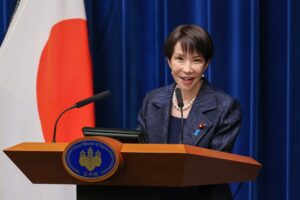
In a sharp diplomatic exchange, Sanae Takaichi, Japan’s newly-appointed Prime Minister, stated that a Chinese military move against Taiwan could constitute a “survival-threatening situation” for Japan.
Following her remarks, China’s Consul General in Osaka, Xue Jian, posted threatening language on social media. Japan then lodged a formal protest, denouncing the statements as “extremely inappropriate.”
This confrontation underscores how sovereignty in East Asia is being tested—not simply by military posturing but by words, social-media posts, and public diplomacy. Japan’s invocation of its right to collective self-defence is a stark signal that the thresholds for intervention are shifting.
Dar es Salaam: Sovereignty Meets Civic Unrest
Meanwhile, in East Africa, the Catholic Church of Tanzania condemned the recent killings of protesters after a disputed national election, stating that there can be no peace without justice.
The opposition claims hundreds–even thousands–of deaths; the United Nations Human Rights Office reports “credible sources” saying at least ten people were killed.
Here, the notion of sovereignty intersects with accountability: the state’s right to maintain order is being weighed against citizens’ rights to protest and dissent. The Church’s intervention frames the dialogue not as one of external interference, but as internal legitimacy.
Brasília: Sovereignty Through Environmental Leadership
In South America, Luiz Inácio Lula da Silva used the leadup to COP30 to call for an accelerated global energy transition and strengthened environmental protection, positioning Brazil as a sovereign actor in climate diplomacy.
At the same time, Brazil reported an 11 % drop in Amazon deforestation ahead of the summit, signalling that sovereignty can also be exercised through stewardship rather than extraction.
Brazil’s posture suggests that sovereignty is evolving into the power to set the agenda, not simply defend territory.
Between Aid and Autonomy: The Global Dilemma
These episodes reveal a larger tension in 21st-century diplomacy: Can nations accept help or engagement without surrendering control? In East Asia, Japan asserts its self-defence prerogative amid U.S.–China competition. In Tanzania, the people demand that sovereignty be accountable. In Brazil, sovereignty translates into leadership in the fight for climate justice rather than dependency.
Why This Matters
The Japan-China dust-up, Tanzania’s civic crisis, and Brazil’s climate pivot go beyond regional headlines; they are a micro-cosm of how the Global South is redefining sovereignty in the 21st century. From diplomacy to defence, from protests to environmental policy, power is being reframed through the lens of autonomy, not merely alignment.
Closing Thought
As the world reconsiders what partnership means, the week’s events remind us: power may lend a hand, but dignity defines how it is received.
References
- Reuters: “Why did Japan PM’s Taiwan remarks cause such a stir?” Reuters+1
- Reuters: “Japan censures Chinese envoy as Taiwan furore escalates.” Reuters
- AP News: “Tanzania Catholic Church condemns the killings of protesters following disputed election.” AP News
- Reuters: “UN rights office alarmed by killings in Tanzania protests.” Reuters+1
- Xinhua News: “Brazilian president urges swift energy transition to curb global warming.” Xinhua News
- Agence France-Presse / CarbonBrief: “Brazil’s deforestation dip ahead of UN climate talks.” Carbon Brief